Showing posts with label Preserving food. Show all posts

Wednesday, September 3, 2025

Pickling...

Well, hello again.  

It's me.

Yes, I am alive and kicking.

In fact, I've had a conversation recently with Hub, where I've told him, if I kick the bucket before he does, he must come on here and inform my beloved readers.  I tell you that, just so you know... when I disappear, and you don't hear anything, I'm probably still breathing.

Truth is, I don't know that I have any good reason why I sometimes disappear for weeks at a time, but it happens and I'm always so grateful to find I have generous visitors who haven't yet given up on me.  I hope that's still true.


Life has been good. 

The weather has markedly improved since I last complained about it.  August went out like it was the beginning of an October Indian Summer.  And the week ahead looks like another cool down.  Summer weather like this is a gift.  I don't imagine we'd appreciate it nearly as much as we do if we didn't have to suffer through a fair amount of hot and humid misery. 

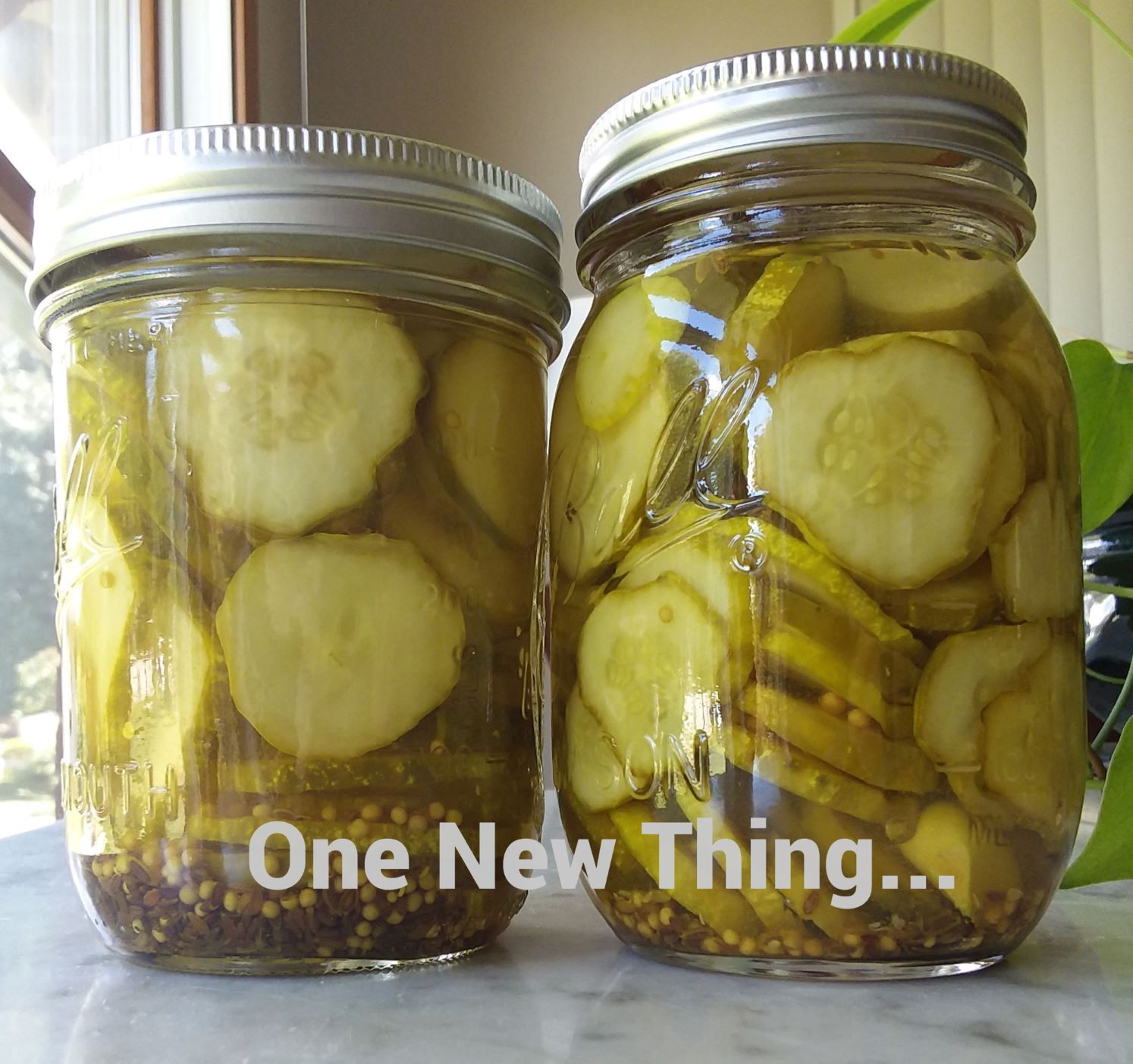
As the summer winds down, my days are a mix of things.  One of these days I plan to write a summary of all the good things this summer, but at the moment I'm a bit preoccupied with pickle making and canning beans.  It's a lot of work, but it is so satisfying to see shiny jars of food filled with things I've grown and preserved.

It's been three years since I've canned pickles and made sweet relish.  I couldn't find the recipes I used in 2022, so I ended up experimenting again with tested recipes.

The heat we had earlier turned a lot of my cucumbers awfully bitter, and unfortunately I had to throw out the first batches of relish and pickles I made a few weeks ago.  

With better temperatures, the cukes are now decent, and I finally accumulated enough, and got up the gumption to make some more relish.


By the time I got to the onions, I was lamenting that I don't own a food processor.  I had a food processor many years ago, and every time I used it I found I hated cleaning it.  So much so that I ended up getting rid of it.  And generally speaking, I haven't missed it. But chopping up all those veggies for sweet relish this time around - especially the onions, had me online pricing what a food processor costs these days.  My hands have lost some stamina, and my crying eyes were begging for relief.


But I persevered, and finally had everything chopped, salted, put under water and into the fridge for 24 hours.  Good thing the recipe called for this long of a salting time. I needed the break.

The next day, I was ready to try out a new-to-me recipe that uses lemon juice instead of vinegar.  I had chopped so many veggies, I was able to make three relish batches, tweaking each one with ingredients to determine what my favorite might be.  

Below is a video I followed (and tweaked) making a lemon juice based sweet relish:


Checking it against a Ball recipe, I am confident that the acidity of the recipe used in the video matches (or exceeds) the tested vinegar-based recipe.


I can't wait to have a taste test with someone(s) to help determine what combination of spices are preferred, and whether there is much difference between using lemon juice or vinegar.  I tasted as I went, but after a while I lost the ability to distinguish much difference between them. I hope to get enough cucumbers still to make at least one more batch of this relish, and try it with less sugar.  

A few jars at a time, I'm also making dill pickles. 


The last time I made dill pickles (in 2022), they lasted me two years.  I have no idea how many pints that was, but last night I finished canning my 17th jar.


I'm the only dill pickle eater here, but I can easily go through a pint jar of dill slices every two or three weeks.  Hopefully, what I've canned is good.  You never truly know until you pop a jar open...

Green beans are pressure canned in small batches too, as that is how they are coming on.  And one of these days, I want to try making a sweet onion relish.  I had some store bought vadalia onion relish a few weeks ago at a pitch-in, and ever since, I've been thinking about making some.

Truth is, I'm not a big sweet relish eater, but I find it fun to make, and when I'm successful with it, I love to give it to people who like it more than me.  It's also good to use in some recipes, so I tend to have a jar in the fridge for those occasions.

So, I'm curious who of my readers are pickle eaters?  Do you like sweet or sour?  Or something in between like bread and butter pickles?  I'm also curious if any of you have experience fermenting pickles?  I'm not sure I'm up for the days-long fermenting process, but my interest has been recently piqued.


Friday, July 26, 2024

"There's more than corn in Indiana"...

The title of this post used to be an Indiana Beach tourism slogan (and jingle) years ago.  I remember thinking then, "Yeah, but what's better than corn?"  Fresh sweet corn on the cob, to be precise.


Every summer we wait for roadside stands to pop up selling freshly picked sweet corn.  These are not the stands that seasonally pop up along busy roads selling a variety of produce.  What I'm talking about are stands that farmers and local small growers place on their own property to sell corn that is usually picked fresh each morning.  Often they are unmanned, and corn is sold on a honor system, with the buyer expected to place cash in a lock box.

Around here, unless you happen to have (or overhear) a conversation with someone about these stands, your only hope of finding them is keeping your eyes open as you drive through the countryside. Since moving to our new home which is a few miles out of town, I have three summers under my belt of traversing somewhat new-to-me country roads on my way from here to there and back again.

Last summer, not even looking for such a stand, I spotted this one, but didn't stop:


It might have been late in the day and I figured there was no fresh corn left.  Or maybe I had no cash on me at the time.  Whatever the reason, I drove on by and figured I'd come back in the next day or two and see if I could still buy some fresh picked sweet corn.  But when I did drive by next, it was gone.  

The window for finding freshly picked sweet corn in central Indiana (and I imagine everywhere in the northern half of the US) is very short and somewhat unpredictable.  All I know is to look for locally grown sweet corn come mid July, but with our unseasonably early and warm spring I had no idea when it would be ready this year.  

For all I knew, we had already missed local corn-on-the-cob season when one day last week, in the late morning, I suggested to Greg that we get in the car and go for a drive, looking for the sweet corn stand I had seen on a county road nearby the year before. With Greg driving, I navigated right to this corner, and to our delight it still held a hundred or more ears of corn.   We boxed up two dozen, dropped a $10 bill in the lock box, and drove home with our treasure.  


In the shade, we shucked the 2 dozen ears, with me planning on freezing what we didn't eat that day.  Youngest son joined us for supper, and everyone agreed it was delicious.  This corn was so worthy of preserving, I sent Greg back the next day to buy a couple more dozen. 

Only being familiar with the tediously hot and messy method of blanching a whole cob, then plunging it in ice water before cutting the kernels off, I googled to check on the time one needed to boil the corn.  But in my searching, I came upon another method:  cutting the corn off the unblanched cob and cooking it for just a few minutes afterwards.  I also came across a nifty way to hold the corn while cutting which creates less mess.   If I had ever seen this before, I had completely forgotten about it.

This method is so simple, it actually is the impetus for me writing this post. 

Here, let me explain and show you (excuse my less than perfectly lit pictures):


After cleaning as much of the silk off the corn as you can, place the fattest end on top of the tube of a bundt or angel food cake pan.  Or simply use a cutting board.  With a sharp knife slice off the kernels - not getting too close to the cob, but not leaving too much behind, either.   I go back and slice down the corners that are created when doing this slicing.

In as large a pot as you need, add some water, just enough to keep the corn from burning (maybe a half - one cup). Bring to a boil, stirring off and on.  Boil for 2-3 minutes.  

If the corn isn't sweet enough, a small amount of sugar and salt can be added during this time.  Full disclosure:  the corn we got the next day wasn't quite as sweet and tender as the corn purchased the day before, and it was starchier.   I suspect it had been picked the day before and refrigerated.  I was disappointed, but it was still tasty, and I was determined to make the best of it.

The first batch that was perfectly sweet and not starchy, didn't need anything added to it to taste delicious.  The second batch, though, about a tablespoon of sugar, and a bit of salt helped greatly (this was added to a pot of corn cut from almost two dozen ears).  Perhaps cooking slightly helped also.  

I mention this because some directions say to add sugar and salt, but if starting with perfectly sweet corn, I'd skip it.  You can taste it raw while slicing it off the cob.  If you're working with less-than-perfectly-sweet or slightly starchy corn, these additions may improve the situation.  Go light, and taste test before adding additional sugar and salt.

After a couple of minutes of boiling, immediately remove from heat and with a slotted spoon, transfer corn onto a shallow baking sheet, or in my case, into a glass baking dish.  


Spread corn into a thin layer.   Discard any water left in pot (should be most of it).  Cover and refrigerate immediately.


After corn is completely cool (I waited a couple of hours), spoon into freezer containers, leaving some head space for expansion.  You don't need a scale, I just happen to have one, and I decided to put just enough for two people in each bag.  

It doesn't look like much in the picture above, but around 8 ounces appeared to be a hearty amount for two people.  I found that 1 cup of corn was right about 6 ounces.  

Freeze and enjoy at your pleasure!
I like the convenience and ease of freezer bags.  Laying them on their sides as they're freezing makes for thin packages that can be stacked or stored in baskets or freezer door shelves when frozen.

Now, if you are frugally minded, you may have already figured that this isn't the cheapest way to get your sweet corn.  Counting what was left after we ate some corn fresh, and having to discard two bad ears, I got 16 freezer bags (with two 4-oz servings each) from 40 ears of corn.  If I've done my math correctly, rounding up a nickel for each ear of corn - which almost compensates for the cost of the quart-sized baggies, each of those frozen bags of corn cost a little over $1.00 each.  For comparison, I can still buy a 15.25 oz can of corn for 69 cents at Aldi, and a 12 oz frozen bag for around a dollar.  

Unless you grow your own sweet corn, this isn't a cost saving activity, but I can't tell you how eagerly I now await eating sweet corn this winter that is fresher than anything I can buy from a store shelf or freezer. Sometimes, when you can make it happen, little pleasures are worth the extra cost in money and time.

But more importantly than that, I am so glad to have found an easy way to preserve sweet corn when I inevitable buy more than we can eat when it's in season.  This level of processing is so very little work, it's barely work at all.  Though, I will say here...  Using a bundt or angel food baking pan (as I showed above) makes this far less messy than simply using a cutting board.  Do I suggest buying one for this purpose?  No.  Am I glad I never rehomed my rarely used bundt pan?  Yes, I am!

I plan to come back to this post this winter (or next spring) and give an update on how good the corn is to eat.  I will edit this post if I am in any way disappointed. Until then, I'm looking forward to eating sweet corn this winter.

Here's a video that shows this process done on a much larger scale:


Friday, April 28, 2023

This is berry good news...

Recently I came upon an idea that got me very excited.  After doing my own experiment, I'm happy to share this new-to-me food storage tip.

Did you know you can store fruits like berries in the fridge, in glass jars, sealed up tight for a longer period of time than if you leave them in the containers they were sold in?   

For how long?  

I don't know for sure, but for quite a bit longer than not storing them this way.

I placed unwashed blueberries in a glass canning jar sealed with a canning lid and canning ring on March 19th.    I didn't remove any air from the jar, and it was only finger tightened.  On April 26th (over a month later) I opened the jar to use the blueberries to make some muffins.  

There was one small little puddle of blueberry juice on the bottom of the jar, but otherwise the blueberries looked perfect.  Not a single one was moldy, or had skin that was compromised.


At this point, I washed them off (for the first time since purchasing them) and let the blueberries dry on a paper towel:


Nothing appears to be wrong with these blueberries.  No smell, no mold growing, and they taste fine.

Now, do I recommend storing berries for over a month in the fridge just because you can?  Well, no...  mostly because I imagine they may have deteriorated in their nutritional content.  And I think these must have been incredibly fresh berries to begin with to have lasted this long.

I would not normally buy blueberries with the intention of storing them this long, but the point is... storing them this way will probably keep them intact and usable for far longer than just popping them in the fridge in their original containers - which for me, almost inevitably means I'm going to end up throwing out at least a few (if not many) berries before I get around to using them.    

I also tried this with strawberries and blackberries.  The strawberries lasted at least a week - maybe longer - before one started getting soft, and I stopped the experiment at that point.  I don't know about you, but before this I had never found a way to store strawberries so that they stayed edible for more than a day or two, max.  

I think I broke into the blackberries about two weeks after storing them, and they were fine. 

When I buy large quantities of berries on sale, my plan is always to wash and freeze quickly what I don't think we'll eat right away.  I will continue to do that, but from now on, I will be taking the fresh berries I expect we'll eat soon out of their plastic containers and storing them in glass jars that I can seal tightly with a lid. That way, if they don't get eaten right away I will have bought myself at least some extra days, maybe more than a week, before they go bad because I lost track of them.

Of course, your mileage may vary with this.  So many things can affect how long fresh fruit will stay edible once we've gotten it home.  How long ago was it picked?  How far did it have to travel?  What conditions was it subjected to before I bought it?  How did I treat it once I got it home?  The number of things that affect fresh produce is kind of endless, and most things are out of our control.  The only thing really in my control is how I store it once I get it home.

So tell me... did you know about this way of storing berries?   It's so incredibly easy, I don't understand why this isn't common knowledge?  Or am I just the last person in the world to know about this?


Tuesday, September 13, 2022

Summer garden is closing...

September started out busy and full, but it's coming to a screeching halt with hand surgery today.  The surgery I'm going to have is CMC Arthroplasty.  It's to relieve basal joint arthritis in the thumb.  I'm having the left hand done first.  If it's a success, then in a year or two I hope to have the right hand done too.  Surgery has felt like a long time coming, and yet it's amazing that it's now here already.  Why is it always that way?

By the time you read this, I may actually be finished with surgery and home!

While I've been quiet online these past few weeks, it's been busy here.  Finishing up a 2021 tax return for my brother's estate, and an amended return for 2020 has been an excruciating experience as I've worked with an accountant that has been a serious disappointment.  But all of it is finally on its way to the IRS and to the State, and I'm relieved to have that task finished.

Other than that, what has occupied me is the stuff of life. I've enjoyed gardening this summer, and doing some food preservation.  There was a real push these last few days to finish up whatever I could since I won't be able to do that kind of thing again 'till my hand heals up.  We ended up giving a bag of cucumbers to friends on Monday because I had other things I wanted to do the day and night before surgery.  I doubt I'll be posting anymore for the rest of the month (unless I can find a draft that's ready to post).  I'll try to visit my blogging buddies in the upcoming days, but if I'm able to type comments I imagine they'll be short and sweet.

Tomatoes, cherry tomatoes, cucumbers, green beans, zucchini, yellow squash, and Marconi Giant sweet peppers have been a regular sight in the kitchen.  I can't believe I've failed to take pictures of it all during these last weeks especially.  While I regret that, I'm happy to be putting away the canner, and unused jars, and all the paraphernalia that goes along with preserving the fruits of summer.  

Here's just a small glimpse into what was happening around here the last few weeks.


These few pictures do not capture all I've been up to.  Because the green beans were ready for picking in too small of batches to can, I froze all of them as I picked them.  What we didn't eat fresh, that is.  Sweet peppers, zucchini and squash were either enjoyed fresh, or were frozen for future use.  And while the last pictures show what I canned, it's just part of what is in the pantry.  

Making pickles was a totally new experience for me.  Dill pickles were fairly easy, but Bread and Butter pickles were a challenge.  The first batch I made I thought were good, and I even shared them with some friends, but after that I just couldn't get the taste right.  I admit I've thrown out almost as much pickled cucumbers as I've ended up with.  One of these days I hope to have a taste test of the batches I've saved with my sons who like B&B pickles.  I'm hoping to find there are a few jars that are worth eating. 

Oh, and I almost forgot...  yesterday I dehydrated a bunch of walking onions for future use.  A large bowl of them were cut up and after dehydrating were reduced to a mere pint-size jar.  My dehydrator (that I hadn't used in many years) didn't appear to be working very well, so I finished them off in the oven.  I should have just started with the oven - I would have saved myself so much time.  Unless these onions are just amazing dehydrated, I don't know that I will do this again in the future.

And that, friend, wraps up a summer of gardening and food preservation.  With strawberries and cherries frozen in the spring time, then peaches in August, and the garden produce "put up" during the last weeks of summer, I'm looking forward to fall and winter and cooking with these things we grew.  

And lastly, while I'm not about to post a picture of myself right now - mostly because I recently got a perm, thinking it would make a great wash & wear hairdo while I'm limited to one hand for a few weeks, nevermind there is nothing wash & wear about it...  I thought I'd look for some old pictures of the first garden Hub and I had.

We rented a small bungalow house when were first married, and the landlords owned a lot with a tilled-up patch behind our house.  They offered it to us to plant a garden if we liked, and we went to it.  Looking at the pictures, I'm amazed at how large it was.  I don't remember if we planted that whole thing, or perhaps just the freshly hoed ground in front of the fencing material behind us.


 Just for fun, this is 22 year-old me, 
and 27 year-old Greg
putting in our first garden.


And me with one of my first jars of home-canned green beans:


I remember being so proud of those green beans.  And proud of being brave enough to use a pressure canner.   I had never canned before that summer, but I grew up hearing the rattling of the pressure regulator on my mother's pressure canner and that was enough to give me courage to give it a go.  I know now there is a rubber safety plug that would have blown out had the pressure built up too much to be dangerous, but I didn't realize that back in 1981.  The canner in the earlier pictures is the same canner I used in 1981.  I believe it was a wedding gift.  I haven't canned in over 20 years, but even for a 42 year-old pressure canner, I was able to easily replace the gasket and an overpressure plug, and it worked perfectly for me.

This is a wrap!  I hope your summer is winding down nicely, and you're looking forward to autumn.  I sure am.  This is my favorite time of year. 


Friday, July 29, 2022

Garden update...


These pictures were taken a week or so ago, and frustratingly, I can only report that the trellised pole beans don't look nearly so nice at this point.  It just so happens we have some critters that love the leaves of green bean plants.  Early in the week I came out to check on things, only to find withered leaves at the top of these Kentucky Wonder pole bean plants.  "That's weird", I thought for a moment.  Then I traced the vine down to a spot where something had chewed through the plant.  Sigh.  Then one evening, as I approached the garden, I saw two cottontail rabbits hopping off toward a group of trees that line the back of the neighbor's yard.  My first thought was, "How cute!"  My second thought was, "YOU are the thieving culprits!"  

Honestly, I wouldn't  really mind if they ate to their hearts' content all the leaves from the bottom of the bean plants - as high they could reach.  But it was disheartening to see that they had chewed through the plant itself - killing it and, frankly, ruining any future meals for themselves.


And the above plant shows how some small bush bean plants were totally decimated - except for two little green beans left on this one.   For some reason, the rabbits have left two larger bush beans alone.  They are being held up by tomato cages, so maybe that has been a small deterrent somehow???

I sprinkled some blood meal around the remaining green bean plants since that's supposed to be a rabbit repellant, but I don't want to overdo blood meal since it's high in nitrogen and I don't think these plants need a lot of nitrogen at this point, so I don't plan to repeat that very often - if at all.  

I also read online that human hair might repel rabbits.  The timing was uncanny as I had trimmed my hair the same day I read that, so I took the little garbage liner bag that still had my hair clippings in it, and sprinkled it around the base of my green beans plants.  I hope I don't gross anyone out with this (I think I grossed a friend out when I told her), but the hair was clean and there was nothing else in the garbage liner so I don't know why this is any grosser than any number of other things I've had my hands in recently.  Besides, if it helps someone else, why not share?  I don't know what was most effective (the hair or the blood meal), but it's been several days and I haven't noticed anymore green bean leaves disappearing.  That said, I'm all but giving up hopes of green beans for more than a few meals this summer.  I need to do more research as I clearly need to be better prepared for rabbits next year.


Fortunately, rabbits don't seem to care for my pickling cucumber plants (pictured above).  They are going gangbusters - having climbed these cages to the tops as of this writing.  I was thrilled this week to finally have a few large enough to pick.


I set to work finding canning directions and a recipe for simple dill pickles.  Lots of people online have lots to say about making and canning pickles, and keeping them crisp, but few (if any) that I came across takes a person step by step from slicing to canning (with a recipe for canning in pint jars) - and that's what I wanted.  So I looked at a number of recipes, watched several videos, learned about the low-temperature pasteurization method (which many claim will produce crunchier pickles), and once I understood that method, I found a simple brine recipe and canned my first pickles:


I've tried to find the recipe I used, but I only wrote down notes while watching a Youtube video and I can't seem to find it now.   I understand the low-temperature process now, so really I just need to experiment with some recipes. Since I go through quite a few jars of dill pickles in a year's time, I figured dill was the first to try.  I need to give these a few weeks before trying them, but my hopes are high and I'm already planning on planting dill in the garden next year!

And while I wait for these pickles to... what?  Ferment? "Ripen"?  What exactly am I waiting for?   I'm not sure, but I'll look it up while I wait for more cucumbers to grow large enough to harvest.   

And I'm waiting for the tomatoes to turn red.   They've looked  approximately this color for weeks now: 

Curious why it's taking them so long to ripen, I looked it up.  Seems our weeks of sustained 90+ degree weather may be responsible for halting the ripening process. Who knew that?  I sure didn't.  I thought tomatoes thrived in hot weather - the hotter the better.  Evidently, not so much.

It's been a few decades since we've gardened (three to be exact), but I seriously don't remember it being this complicated.  We hoed the ground, stuck seeds in the dirt, watered the garden from time to time, and things just grew.  Or so it seemed.  I need to find some pictures and remind myself of what our gardens looked like if I can.  I know I've got at least one picture of me happily holding my first canned green beans.  Or maybe it was tomatoes.  Regardless, we actually produced things without all this hubbub.  And without the internet at our fingertips to answer every question we had.  And questions we didn't have.  When the temps get back into the 90's, I'll go digging through the photo albums and see what I can find.  

Anyway...  I might be disappointed, but I'm hoping the tomatoes ripen by mid-late August or early September so I have time to preserve them.  I have hand surgery scheduled for mid September - at which point, my canning/freezing days will come to a halt for at least a few weeks.  While I enjoy being generous, I confess I hope we don't have to invite friends over to pick and take home tomatoes in September, like we did with our strawberries in June.  

There are certainly worse things that could happen, though, I suppose.

Oh yeah...  and there's this:  
 

A peach tree we didn't realize was a peach tree!  And suddenly, it's full of fruit.  I thinned the fruit today (I learned last night that should have been done when the peaches were less than quarter size), but we never saw these coming!   We may have missed our opportunity for helping this tree produce decent fruit this year, but it's kind of fun having just discovered it loaded down with beautiful peaches. They're kind of small, but they're purty.

To be honest, I have mixed feelings about having a peach tree.  I say we should give it another year and see if we can manage it, but if not (or if it doesn't produce fruit worth picking), I know we'd rather not deal with having to clean up falling fruit, and the insects it will attract.  It will be interesting to see what happens with this tree over the next few weeks...

More and more, we're seeing our job with this new place is to simplify the landscape.  There have been some cool things to discover, for sure, but seriously...  no one is going to be unhappy with this property when it comes time to sell if we've tamed it and made it more manageable.

And that's a wrap for another week.